


Lead Work & Flashing Repair in Esher, Claygate & Oxshott
Our roofing team brings over 30 years of hands-on experience to lead work and flashing repairs, from a single cracked apron flashing over a bay window to a full lead valley that needs stripping out and re-laying. Wherever a roof meets a wall, a chimney or another roof plane, it relies on lead to form a continuous, weathertight seal – and when that lead cracks, lifts or goes missing, it’s one of the fastest routes for water to get into a roof structure. This page sets out the different types of lead work we repair, what causes flashing to fail, when a lead alternative like GRP is worth considering, and what it costs – no subcontracted labour, no unnecessary work.
What Sets Our Lead Work & Flashing Repairs Apart
Every lead repair is carried out by our own employed roofing team, not passed on to a subcontractor we’ve never worked with before. That matters on lead work specifically, because a poorly dressed joint or the wrong lead code for the job can look fine on the day and still fail within a couple of years, letting water track in at exactly the junction it was meant to protect. Our team works to BS 6915 detailing practice – correct lead code selection, properly sized bays, and movement joints that let the lead expand and contract without splitting – across the older, mixed-age roof stock that’s typical of Esher, Claygate and Oxshott. Every repair is backed by our own workmanship guarantee.
How We Diagnose and Approach Every Lead & Flashing Repair
Failing lead can be hard to spot from ground level, so every lead repair we quote starts with a proper inspection – either ladder access or a drone roof inspection – checking every abutment, valley and chimney junction for cracked, lifted or missing lead, not just the spot where a stain has already appeared inside. That’s important because a small step flashing repair over a bay window needs a very different approach to a full valley re-lay, and treating the wrong one wastes money. As standard, our lead work service includes:
- A written, fixed-price quote that specifies exactly which lead work is needed – re-dressing, soaker replacement, or a full valley or flashing renewal
- Photographic evidence of the cracked, lifted or missing lead, so you can see what we’re fixing and why
- The correct lead code (weight) specified for each application, in line with BS 6915 guidance, rather than a one-size-fits-all sheet
- A tidy site once the work’s done, including clearing off-cuts and old lead from gutters and the ground below
Where some repairs get quoted as a flat “reseal the flashing” using sealant or mastic alone, we’d rather dress and lap the lead correctly the first time, because sealant over a poorly formed joint might hold for a season, but it’s not a substitute for a proper mechanical seal.
Our Lead Work & Flashing Repair Process
- Diagnosis – we inspect every abutment, valley and chimney junction by ladder or drone, checking for cracked, lifted, or missing lead and tracing exactly where water is tracking in.
- Fixed-price quote – you get a written quote for the specific repair needed, with photos showing the damage and the lead code we’ll use.
- Repair – we strip out the old, failing lead, form new flashings, soakers or valley linings to the correct code and bay size, and dress and lap every joint to give a continuous, weathertight seal rather than relying on sealant alone.
- Site clean-up – we clear old lead, off-cuts and any debris from gutters and the ground before we leave.
- Sign-off – we confirm the repair’s complete, back it with our workmanship guarantee, and can share photos of the finished lead work.
Signs Your Lead Work or Flashing Needs Attention
Flashing problems are easy to miss because they’re usually tucked into a junction you don’t look at closely, and by the time a stain shows up on a bedroom ceiling or around a chimney breast, water’s often been tracking in for a while. Typical warning signs include a damp patch or discolouration on an internal wall or ceiling near a chimney or roof-wall junction, lead that’s visibly cracked, split or lifted away from the brickwork, daylight visible at an abutment if you get into the loft, and – less obviously – lead that’s simply gone missing, which does happen given its scrap value. Moss and debris building up in a valley is also worth a look, since a blocked valley holds water against the lead for longer than it should. If you’re not sure what you’re looking at, a drone roof inspection gives us a clear photographed view of every junction before we recommend a repair.
The Different Types of Lead Work We Repair
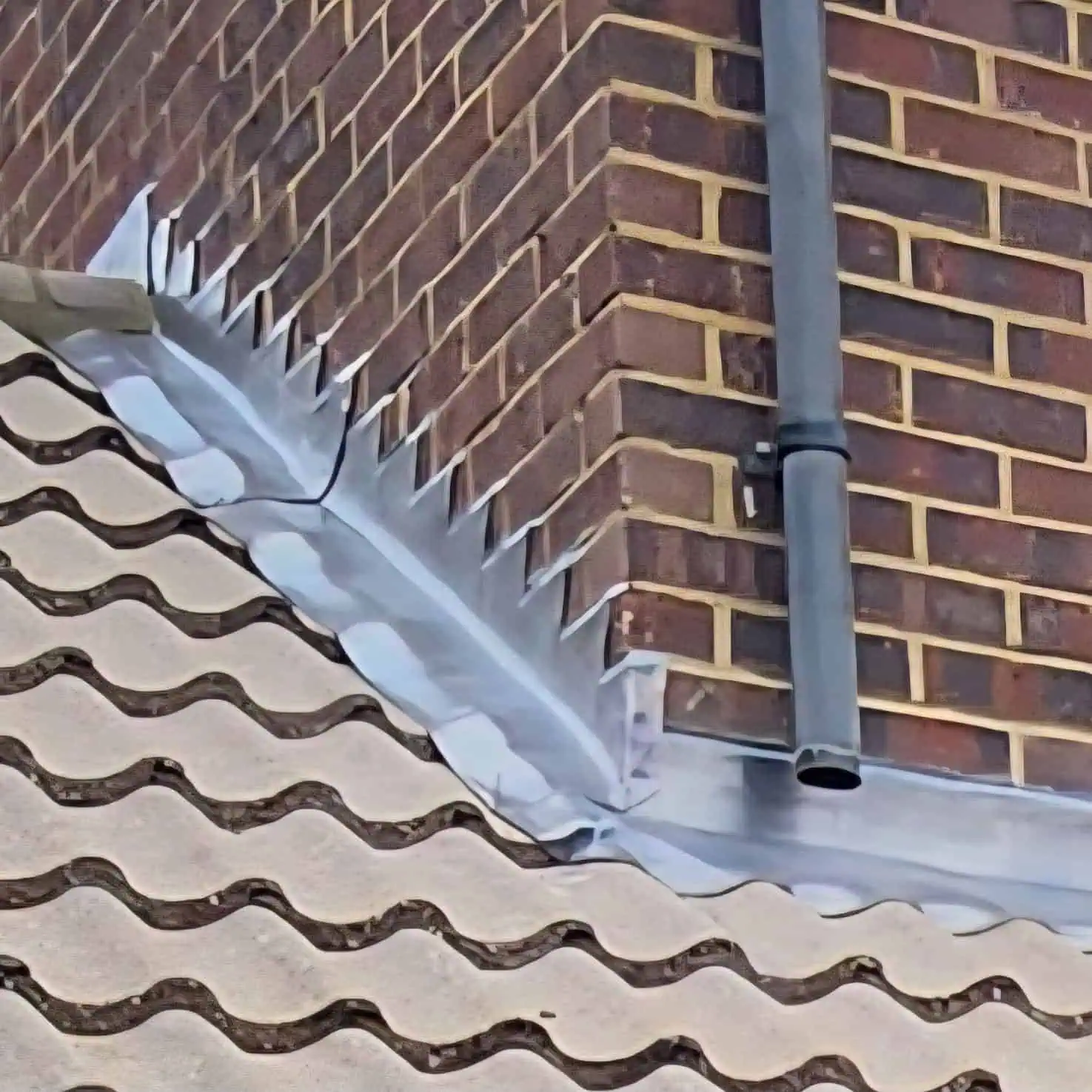
“Flashing” covers several distinct details, and knowing which one has failed is the first step to fixing it properly. Step flashing is the stepped, overlapping lead used where a pitched roof slope meets a wall, such as along the side of a chimney breast – each piece dressed into a brick joint and lapped over the one below. Apron (or cover) flashing is a single, continuous run of lead used where a roof meets a wall square-on, common at the top of a lean-to or where a roof abuts a chimney breast face. Lead soakers are small individual pieces of lead, usually the lightest code, tucked under each slate or tile course and dressed up the wall behind the visible flashing – they’re what actually stops water getting through at that junction, with the step flashing over the top protecting the joint. Valley linings run down the internal angle where two roof pitches meet, channelling a significant volume of water off the roof, which is why they need a heavier lead code than a soaker or step flashing. We repair and renew all of these, matching the lead code to what each detail actually needs rather than using the same sheet everywhere.
Lead vs GRP: Which Is Right for Your Valley or Flashing?
Traditional lead has been the standard material for flashings and valleys on UK roofs for generations, and correctly detailed to BS 6915 – with the right code, properly sized bays, and movement joints – it can last decades. It’s also the right choice where a period or listed property needs to match its existing detailing. GRP (glass-reinforced polyester) valley and flashing systems are a more recent alternative: lighter to handle, not vulnerable to the metal theft that affects lead on some properties, and available in closed designs that protect cut tile edges from storm damage in a way an open lead valley can’t. Neither option is automatically “better” – it depends on the roof, the property, and what’s failed before. If your lead has been stolen more than once, or you’d simply rather not think about it again, a GRP valley is usually worth considering; if you’re repairing a single damaged section on an otherwise sound lead roof, matching the existing material is often the more cost-effective repair. We’ll always give you an honest recommendation for your specific roof rather than pushing one option by default.
How Much Does Lead Work & Flashing Repair Cost in Esher and Surrey?
Lead work costs vary more than most other roofing jobs, because the range runs from a single soaker or a short length of step flashing to a full valley re-lay or lead theft replacement across a whole roof. What drives the price is how much lead is affected, which type of detail it is (a valley uses significantly more lead than an apron flashing), access (a roof ladder is often enough, though chimney work or a longer valley may need a scaffold tower), and whether you’re matching like-for-like in lead or switching to a GRP alternative. As a guide, a single failed soaker or a short run of step flashing is usually the quickest and most affordable job we quote, while a full valley re-lay or a lead theft replacement on a longer roof costs more, in the same way a bigger job always costs more than a smaller one. We’ll always confirm the exact, fixed price in writing after we’ve inspected the lead work – not before.
Frequently Asked Questions
How do I know if my flashing or lead work has failed?
The most common sign is a damp patch or staining on a ceiling or wall near a chimney or where a roof meets a wall. From outside, look for lead that’s visibly cracked, lifted, or missing. If you’re not sure, we can check it for you as part of a fixed-price inspection.
What causes lead flashing to fail in the first place?
Most failures come down to how it was originally installed – bays cut too large, no movement joints, the wrong lead code for the job, or poor fixing – rather than the lead itself wearing out. General weathering, physical damage from debris, and lead theft are the other common causes.
Is lead flashing still the best choice, or should I switch to GRP?
It depends on the roof. If you’ve had lead stolen before, or want a lower-maintenance long-term fix, a GRP valley or flashing is usually worth it. If you’re repairing a single section on an otherwise sound lead roof, matching the existing lead is often the more cost-effective and better-matched repair – we’ll give you an honest recommendation either way.
Do you use genuine lead or a lead alternative?
Both, depending on what’s right for your roof. We work with traditional rolled lead sheet to the correct BS 6915 code for the application, and we also fit GRP valley and flashing systems where that’s the better fit. We’ll talk you through the options before any work starts.
Do you offer a guarantee on lead work and flashing repairs?
Yes – every repair is backed by our own workmanship guarantee. Full details are confirmed as part of your written quote.
How quickly can you get to a leaking chimney or failed flashing?
Straightforward flashing and soaker repairs can often be booked in within a week or two; if you’re dealing with an active leak, call us directly and we’ll prioritise accordingly.
What Our Customers Say
We currently hold over 70 positive Google reviews at 5 stars. Recent lead work – including a lead valley and flashing repair in Claygate where the original flashing around a chimney breast had cracked and pulled away from the brickwork – has restored roofs to being fully protected against wind-driven rain and water tracking at some of a roof’s most vulnerable junctions. You can read the full reviews on our Google Business Profile, or get in touch directly for references from recent, comparable lead work jobs.
Lead Work & Flashing Repairs Across Esher, Claygate, Oxshott and the Surrounding Area
Alongside Esher, Claygate and Oxshott, we regularly carry out lead work and flashing repairs in Thames Ditton, Hinchley Wood, Weybridge and Cobham. Lead work very often comes up alongside other issues at the same junction – a failing chimney that needs repointing where the flashing meets it, or wider tile damage nearby – and we can quote for that as part of the same visit rather than sending someone else out separately. For roof problems away from a specific junction, see our general roof repairs page.
Need Lead Work or Flashing Repairs in Esher, Claygate, Oxshott or Surrey?
If a leaking chimney, cracked flashing or a damp patch that’s appeared out of nowhere has you thinking about a repair anywhere in Esher, Claygate, Oxshott or the wider Surrey area, our team can take a look and give you a clear, fixed-price quote. Get in touch today.
